We are now a couple months into the Academic Games season and are already playing four of the six games that we play during the year.
The first game we started was Equations, which is a game in which our players demonstrate their amazing mathematical skills. For a slightly outdated version of the basics of this game and a cat, check out this youtube video by Clague alumna Claire Fishman.
We have also added On-Sets, a game of set theory that is explained earlier in this blog at this link. We have been playing On-Sets and Equations at our Friday Tournaments and will be playing them at this month's Saturday Tournament on the 18th.
We have also started playing our U.S. History game, Presidents. To learn about this game, there is also a blog post from earlier. This year we learn about the terms of the first 24 presidents (Washington through Cleveland).
Finally, we have started learning WFF 'n' Proof, a formal logic game.
The two other games Clague competes in -- Propaganda and Linguishtik -- will be started in the coming months.
Showing posts with label introduction to games. Show all posts
Showing posts with label introduction to games. Show all posts
Friday, November 10, 2017
Sunday, September 25, 2016
What is the Game of Presidents?
Presidents is a game about U.S. History in which a series of clues are given about a President and the goal is to identify him. Presidents are identified by their number (Washington is #1, Obama is #44).
The players are each given a sheet (which we call a “gazetteer”) giving the number of the President, his name, his years in office, his political party, and the year and state of his birth and death.
The players are given a “range” within which the answer will fall. For example, the range might be 35-44.
First, a "six-point clue" is read about the President (in the first person). This is usually the most difficult clue. For example,
“Soon after my birth, my parents separated. I went with my mother to live in a different state. After she remarried, I was renamed after her second husband. “
Based on this, players choose whether to
write down an answer or wait for more clues. If the answer turns out to
be right, they will get six points, but a wrong answer gets no points in
Presidents.
Next, a "four-point clue" is read about the same President. For example,
Next, a "four-point clue" is read about the same President. For example,
“I played football for my college team and served as a representative from the same state for many years, eventually serving as leader of my party in the House of Representatives. I served on the Warren Commission investigating a Presidential assassination. I left my position in the House of Representatives to become Vice President.”
Players who
haven't answered the six-point clue choose whether to answer or not -- this
time getting four points if they are correct – and zero if they are wrong. Then, a "two-point clue" is read. This clue is usually easier than the
others.
“I became Vice President when my predecessor resigned, and similarly became President when my predecessor resigned. As such, I am the only President never elected to national office”.
Players who haven't answered
yet answer now since it is the last chance for points. Finally, the President (#38 - Ford) is identified, scores are recorded, and the game moves on to the next question.
For tips on studying for Presidents, have a look at an earlier blog post.
At the elementary and middle levels, Academic Games covers half of the Presidents each year. This year (2016-17) we cover #25-44 (McKinley through Obama).


Sunday, November 1, 2015
Follow Us On Twitter; also a classic film introducing Equations
If you are reading this on a mobile device or have an ad blocker running, you probably can't see our twitter feed on this blog page, so you may be missing out. We tweet at @clagueag so follow us.
Also, if you want to show someone what Equations is like or want to see for yourself, Clague alumna (and a winner this year of the Academic Games Outstanding Senior award) Claire Fishman has a video on youtube explaining the basics of Basic Equations. The video is a few years old so a couple rules have changed, but on the other hand, there are cats.
Also, if you want to show someone what Equations is like or want to see for yourself, Clague alumna (and a winner this year of the Academic Games Outstanding Senior award) Claire Fishman has a video on youtube explaining the basics of Basic Equations. The video is a few years old so a couple rules have changed, but on the other hand, there are cats.
Wednesday, October 28, 2015
The Game of On-Sets
We have now moved along to playing On-Sets (in addition to Equations and Presidents) during our practices.
Clague players will already know everything in this post, but just in case some parents or people interested in learning Academic Games are reading, here is a (very) simplified version of what On-Sets is about.
On-Sets is a game of set theory, and therefore a game of logic. The game consists of cards, cubes, a timer, a "flub", and a board.

Cards have between zero and four colored dots on them -- blue, red, green, or yellow. This means there are 16 (=2^4) cards in the set. Only some of them are dealt (face-up) and these become the "universe".
There are several types of cubes. Eight have colors on them. A yellow cube means the set of all cards which have a yellow dot on them -- and similarly for blue, red, and green. Seven of the other cubes mostly have set operators such as union, intersection, and complement. [If you're new to set theory, it might be helpful to see the Wikipedia Page on basic set theory]
The three remaining cubes have digits on them. One player -- the "goal-setter" -- uses these cubes to form a numeric goal. Players must then be prepared to write an expression using set theory where the number of cards in the universe described by their formula equals the goal that was set.
The rest of the game is similar to Equations -- as cubes are moved onto the various sections of the board it changes which cubes must (or must not) be used in solutions, and players look for opportunities to "challenge" the moves of their opponents.
There is a lot more to On-Sets -- particularly at the Adventurous level that the Clague team plays at. The complete rules and other documents about the game can be found at the Michigan Leagues of Academic Games website
Clague players will already know everything in this post, but just in case some parents or people interested in learning Academic Games are reading, here is a (very) simplified version of what On-Sets is about.
On-Sets is a game of set theory, and therefore a game of logic. The game consists of cards, cubes, a timer, a "flub", and a board.
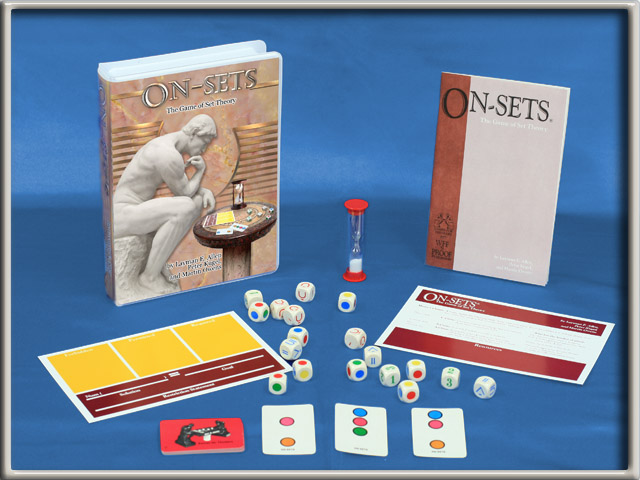
Cards have between zero and four colored dots on them -- blue, red, green, or yellow. This means there are 16 (=2^4) cards in the set. Only some of them are dealt (face-up) and these become the "universe".
There are several types of cubes. Eight have colors on them. A yellow cube means the set of all cards which have a yellow dot on them -- and similarly for blue, red, and green. Seven of the other cubes mostly have set operators such as union, intersection, and complement. [If you're new to set theory, it might be helpful to see the Wikipedia Page on basic set theory]
The three remaining cubes have digits on them. One player -- the "goal-setter" -- uses these cubes to form a numeric goal. Players must then be prepared to write an expression using set theory where the number of cards in the universe described by their formula equals the goal that was set.
The rest of the game is similar to Equations -- as cubes are moved onto the various sections of the board it changes which cubes must (or must not) be used in solutions, and players look for opportunities to "challenge" the moves of their opponents.
There is a lot more to On-Sets -- particularly at the Adventurous level that the Clague team plays at. The complete rules and other documents about the game can be found at the Michigan Leagues of Academic Games website
Monday, October 19, 2015
The Game of Presidents
Since today is Election Day (in Canada), it seemed a good opportunity to explain the game of Presidents, particularly for the new families who are hearing about this game from the students.
Presidents is a game about U.S. History in which a series of clues are given about a President and the goal is to identify him. Presidents are identified by their number (Washington is #1, Obama is #44).
The players are each given a sheet giving the number of the President, his name, his years in office, his political party, and the year and state of his birth and death.
First, a "six-point clue" is read about the President. Based on this, players choose whether to write down an answer or wait for more clues. If the answer turns out to be right, they will get six points, but a wrong answer gets no points in Presidents.
Next, a "four-point clue" is read about the same President. Players who haven't answered the six-point clue choose whether to answer or not -- this time getting four points if they are correct.
Then, a "two-point clue" is read. Players who haven't answered yet answer now since it is the last chance for points.
Finally, the President is identified, scores are recorded, and the game moves on to the next President.
For some tips on studying for Presidents, have a look at an earlier post on the topic.
In high school, players have to know every President every year, but until then, the list is split in two. The 2015/16 year covers Presidents #1-24 (Washington through Cleveland).
Presidents is a game about U.S. History in which a series of clues are given about a President and the goal is to identify him. Presidents are identified by their number (Washington is #1, Obama is #44).
The players are each given a sheet giving the number of the President, his name, his years in office, his political party, and the year and state of his birth and death.
First, a "six-point clue" is read about the President. Based on this, players choose whether to write down an answer or wait for more clues. If the answer turns out to be right, they will get six points, but a wrong answer gets no points in Presidents.
Next, a "four-point clue" is read about the same President. Players who haven't answered the six-point clue choose whether to answer or not -- this time getting four points if they are correct.
Then, a "two-point clue" is read. Players who haven't answered yet answer now since it is the last chance for points.
Finally, the President is identified, scores are recorded, and the game moves on to the next President.
For some tips on studying for Presidents, have a look at an earlier post on the topic.
In high school, players have to know every President every year, but until then, the list is split in two. The 2015/16 year covers Presidents #1-24 (Washington through Cleveland).
Subscribe to:
Posts (Atom)